

| Chung Hyun Tae | 3 Articles |
|
[English]
Purpose
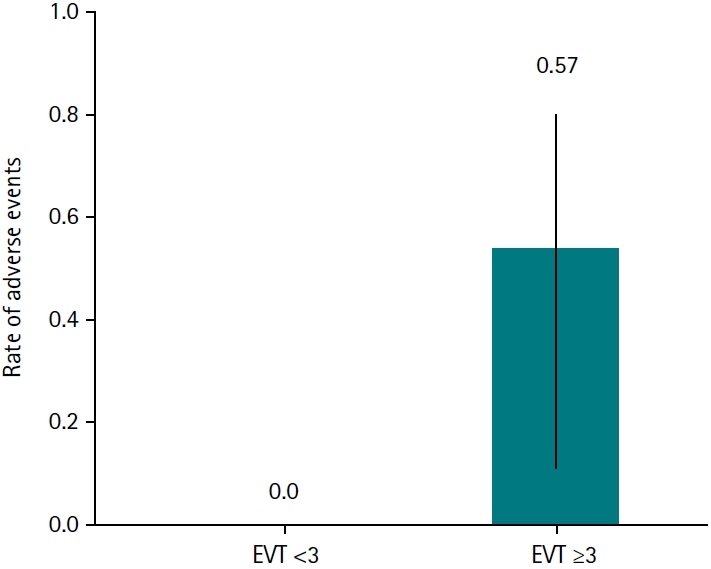
Endoscopic vacuum therapy (EVT) has emerged as a highly effective approach for managing gastrointestinal transmural defects and may offer advantages over traditional methods, such as stenting. This study evaluated the clinical outcomes of EVT for gastrointestinal transmural defects resulting from leakages, perforations, and fistulas. Methods We retrospectively reviewed patients who underwent EVT for gastrointestinal transmural defects at Ewha Womans University Medical Center between February 2018 and September 2025 and analyzed clinical outcomes, adverse events, and risk factors associated with adverse events. Results Fourteen patients were included (mean age, 63.9 years; 85.7% male). Stomach surgery was the most common etiology (50.0%), and malignancy accounted for 71.4% of cases. The median number of EVT sessions was 2.5, and the mean interval from the index event to the first EVT session was 10.5 days. EVT achieved a 100% technical success rate, with no 30-day mortality; there was 1 in-hospital death (7.1%), 2 cases of stricture (14.3%), and 1 major bleeding event (7.1%). Adverse events were observed more frequently in patients who underwent ≥3 EVT sessions (57.1%) compared with those who underwent <3 sessions, in whom no adverse events occurred. Conclusion This study suggests that EVT is a safe and effective treatment for gastrointestinal transmural defects, with high technical success rates. The number of EVT sessions and the timing of treatment initiation appeared to be associated with complications and overall clinical outcomes.
[English]
Gastric sarcoidosis is a rare disease accounting for 0.1~0.9% of all sarcoidosis cases. It presents either as a systemic disease or as an isolated finding. Diagnosis is established with biopsy of a lesion. It is important to distinguish between sarcoidosis and a sarcoid-like reaction, which can be caused by Crohn's disease, foreign body reaction, fungal infection, tuberculosis, or malignancy. We report a 60-year-old woman with both gastric and pulmonary sarcoidosis.
[English]
Ingestion of corrosive substances can produce severe injury to the gastrointestinal tract and can even result in death in the acute phase. The extent and degree of damage depends on the type and amount of substances. There are occasional reports of severe contiguous injury to the esophagus and stomach caused by strong alkali ingestion in the acute phase. Usually the deaths occur within a couple of days due to multi-organ failure after ingestion of relatively much amount of agent for a suicidal attempt. But death due to late progression is very rare. We have reported a case of 60-year-old female patient who was diagnosed as corrosive esophagitis after accidental ingestion of strong alkali. Initial endoscopic findings were compatible with IIa-IIa-0(according to Zargar's classification) in the esophagus, stomach and duodenum, respectively. After several weeks of supportive care, her subjective symptoms were much improved during she had been wating for the operation of colon interposition due to esophageal stricture. Metabolic acidosis and thrombocytopenia developed abruptly probably due to upper gastrointestinal tract necrosis and she died when 60 days had passed after the occurrence of initial esophageal injury. Citations Citations to this article as recorded by

|
|
 , Ki-Nam Shim