

| Seung Hee Yoo | 5 Articles |
|
[English]
Purpose
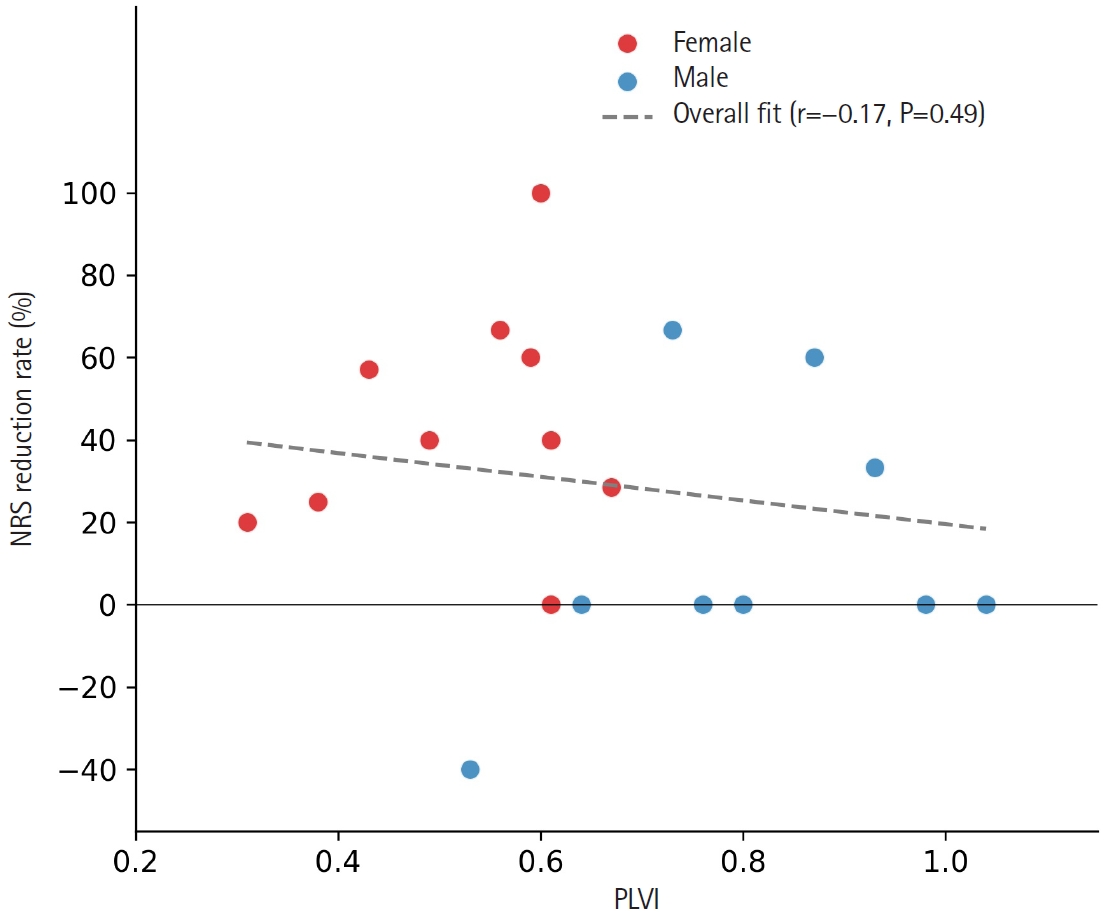
The psoas–lumbar vertebral index (PLVI), a marker of central sarcopenia measured using computed tomography (CT) or magnetic resonance imaging (MRI), has been linked to the development of postherpetic neuralgia (PHN). Whether PLVI predicts short-term pain relief after pulsed radiofrequency (pRF) treatment of the dorsal root ganglion (DRG) in established PHN remains unknown. This pilot study examined the association between PLVI and the reduction in numeric rating scale (NRS) pain scores 1 month after pRF. Methods Patients with PHN who underwent DRG pRF and had CT or MRI scans available for PLVI measurement were retrospectively reviewed. Correlations of the NRS reduction rate with PLVI and other variables were assessed, with 95% confidence intervals (CIs). Patients were divided into low- and high-PLVI groups using sex-specific medians and compared; multivariable regression was adjusted for sex. A supplementary responder analysis used thresholds of ≥30% and ≥50% reduction. Results In 19 patients, NRS scores decreased from 4.8±1.7 to 3.2±1.7, with a reduction rate of 29.3%±34.0%. PLVI was not significantly correlated with the reduction rate (r=−0.17; 95% CI, −0.58 to 0.31; P=0.49); neither the reduction rate (P=0.71) nor responder rates differed between the low- and high-PLVI groups. Male sex was associated with a smaller reduction (adjusted B=−47.2 percentage points; 95% CI, −90.9 to −3.5; P=0.036), although the unadjusted group comparison was not significant (Welch P=0.051) and 15 variables were tested without correction for multiple comparisons. Conclusion This pilot cohort showed no detectable association between PLVI and short-term pain relief after pRF; its small size precludes establishing the absence of an association. The exploratory sex difference warrants investigation in larger prospective studies with comprehensive sarcopenia assessment.
[English]
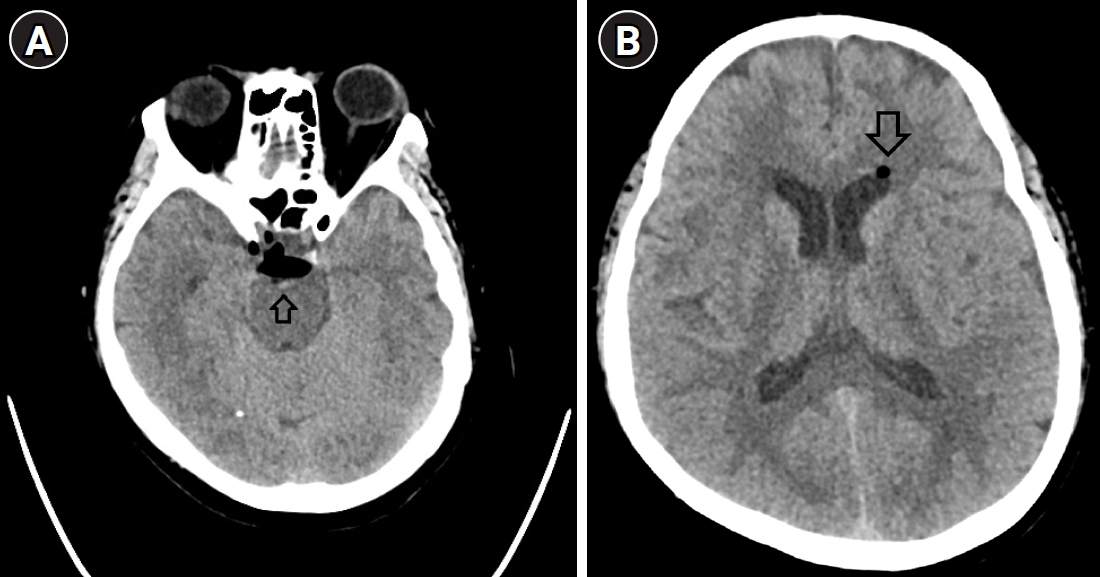
Pneumocephalus is a rare complication of neuraxial procedures and is usually associated with inadvertent dural puncture or the use of air during epidural space identification. Epiduroscopic epidural neuroplasty (EEN) is performed without air injection and permits direct visualization of the epidural space; therefore, pneumocephalus after this procedure is extremely uncommon. A 71-year-old woman with a history of lumbar spine surgery underwent EEN via a caudal approach without sedation. No dural puncture was identified during the procedure. Approximately 12 hours later, she developed a non-orthostatic headache. Brain computed tomography revealed pneumocephalus in the basal cistern and left lateral ventricle. Her symptoms improved with oxygen therapy but worsened 5 days later despite radiologic resolution of the pneumocephalus. Suspected cerebrospinal fluid (CSF) leakage was treated with an epidural blood patch, which resolved her symptoms. Pneumocephalus may occur after EEN without clinically or endoscopically recognized dural injury and may coexist with CSF leakage; an occult microdural defect cannot be excluded as the underlying mechanism. Prompt imaging should be considered in patients who develop early or atypical postprocedural headache.
[English]
OxyMask, a novel product, has recently been used to administer oxygen postoperatively to patients who have undergone general anesthesia. This study aimed to evaluate the incidence of hypoxia in patients under general anesthesia upon arrival to the post-anesthesia care unit (PACU) using arterial blood gas analysis, and to compare the effectiveness of OxyMask with a non-rebreathing oxygen mask for oxygen administration. We retrospectively investigated anesthesia-related data from the electronic medical records of 460 patients treated from April to November 2021. We analyzed patients aged 20 years or older who had undergone general anesthesia and whose perioperative arterial blood gas analysis results were available upon arrival to the PACU. These patients were grouped into the non-rebreathing oxygen mask (n=223) and OxyMask (n=237) groups, and statistical analysis was performed utilizing their anesthesia records. No patients exhibited hypoxia upon arrival to the recovery room. The oxygen concentration increased after oxygen administration; its concentration during the recovery room period (Δ2 PaO2) was 10.7±42.3 and 13.9±38.5 mmHg in the non-rebreathing oxygen mask and OxyMask groups, respectively. This difference was not statistically significant. Moreover, the arterial oxygen saturation between the end of surgery and upon arrival to the PACU (Δ1 SaO2) and the arterial oxygen saturation 20 minutes after oxygen administration at the PACU (Δ2 SaO2) did not significantly differ between the groups. OxyMask was not superior to a non-rebreathing oxygen mask in terms of the effectiveness of oxygen supply.
[English]
ABSTRACT
Variant angina, which is associated with coronary artery spam, is difficult to recognize on routine preoperative evaluation. Coronary spasm results in myocardial ischemia and even lethal arrhythmia in severe cases. Since patients are unconscious and cannot complain of symptoms during general anesthesia, early detection of such an event is difficult, and it could lead to severe bradycardia or cardiac arrest. We report a case of a patient with previously undiagnosed variant angina who experienced severe hypotension and ventricular fibrillation during general anesthesia. Citations Citations to this article as recorded by

[English]
An 84-year-old woman visited our pain clinic with complaints of low back pain and severe radiating pain in the right lower extremity during walking. The patient demonstrated subacute compression fracture of L3 with vacuum change in lumbar spine plain radiographs and MRI which suggest Kummell’s disease. Despite our conservative treatments, she had little back pain relief. Therefore, we planned a percutaneous vertebroplasty. Manual compression could help perform percutaneous vertebroplasty more effectively by expanding the vertebral body. In addition, the spontaneous recovery of vacuum cleft width using negative pressure could help perform the technique more effectively. We successfully performed percutaneous vertebroplasty using these combination therapies for our patient.
|
|
 , Eunbi Cho