Context
SKYVaricella is a live attenuated varicella-zoster virus vaccine, developed by the Korean manufacturer, SK Bioscience. The Ministry of Food and Drug Safety (MFDS) first approved it in 2018, and the World Health Organization (WHO) granted prequalification in 2019. It is currently one of 4 WHO prequalified varicella vaccines. In its phase 3 trial, the vaccine demonstrated immunogenicity non-inferior to Varivax, but it has not been evaluated for protective efficacy, durability of immune response, long-term safety beyond 26 weeks, or adverse events occurring in fewer than 1 in 330 recipients [
1].
A reported fatal case of disseminated vaccine-virus varicella in a SKYVaricella-vaccinated child prompted a joint safety assessment by the Korea Disease Control and Prevention Agency (KDCA) and the MFDS in 2024 [
2]. The agencies concluded that SKYVaricella did not cause the fatal case and that no immediate safety concern warranted removal from the National Immunization Program (NIP) [
3]. However, they identified an increased risk of herpes zoster (HZ) in SKYVaricella-vaccinated children. They announced plans to strengthen risk management, but no detailed risk minimizing actions or follow-up updates in benefit-risk assessment have been released.
SK Bioscience updated the vaccine’s risk management plan (RMP) in August 2024. The revision removed most of misclassified safety concerns from the initial RMP and added HZ as an important potential risk [
4,
5]. It also introduced educational materials for patients and physicians as additional risk minimization measures (RMMs), although the materials did not describe HZ characteristics in vaccinated children [
6]. Despite acknowledging the new safety concern in the RMP, the manufacturer has not properly updated the product information and continues to assert that no new safety concern exists [
7].
Since the KDCA and MFDS press briefing, new evidence has emerged. Kim et al. [
8] reported a case series of 23 children who developed HZ after SKYVaricella vaccination between February 2021 and March 2024; 43.4% required hospitalization. At the population level, Lee [
9] conducted an ecological study using Korean National Health Insurance Service data and estimated 6,484 excess HZ cases potentially due to SKYVaricella vaccination in Korean children under 5 years of age from January 2019 to June 2024. Although these studies describe the frequency, seriousness, and public health impact of HZ in this population, Korean authorities have not commented on the findings, and it remains unclear whether they have re-evaluated the vaccine’s risk-benefit profile in light of this new information.
Korean authorities and the manufacturer appear to have publicly denied—or only ambiguously acknowledged—the emerging safety concern of HZ [
3,
7]. Despite this, they have initiated new studies to evaluate the HZ risk associated with SKYVaricella. This article reviews those studies and examines their implications for managing SKYVaricella-related HZ risk.
Medicinal products receive regulatory approval once they demonstrate sufficient safety data to support a favorable risk-benefit balance for their intended indications. After commercial launch, additional safety data accumulate through routine use and expansion of indications. Because these data are large in volume and diverse in type, regulators and manufacturers apply predefined thresholds or criteria to screen for potential issues. Safety information that meets these criteria is flagged as a “signal” for further assessment. When an in-depth evaluation suggests a reasonable causal association between a signal and a medicinal product, the detected signal is classified as an identified or potential risk. If this risk is considered significant in terms of impact on public health or on individuals, it is designated as an important identified risk or an important potential risk. Important identified or important potential risks are defined as safety concerns [
10,
11].
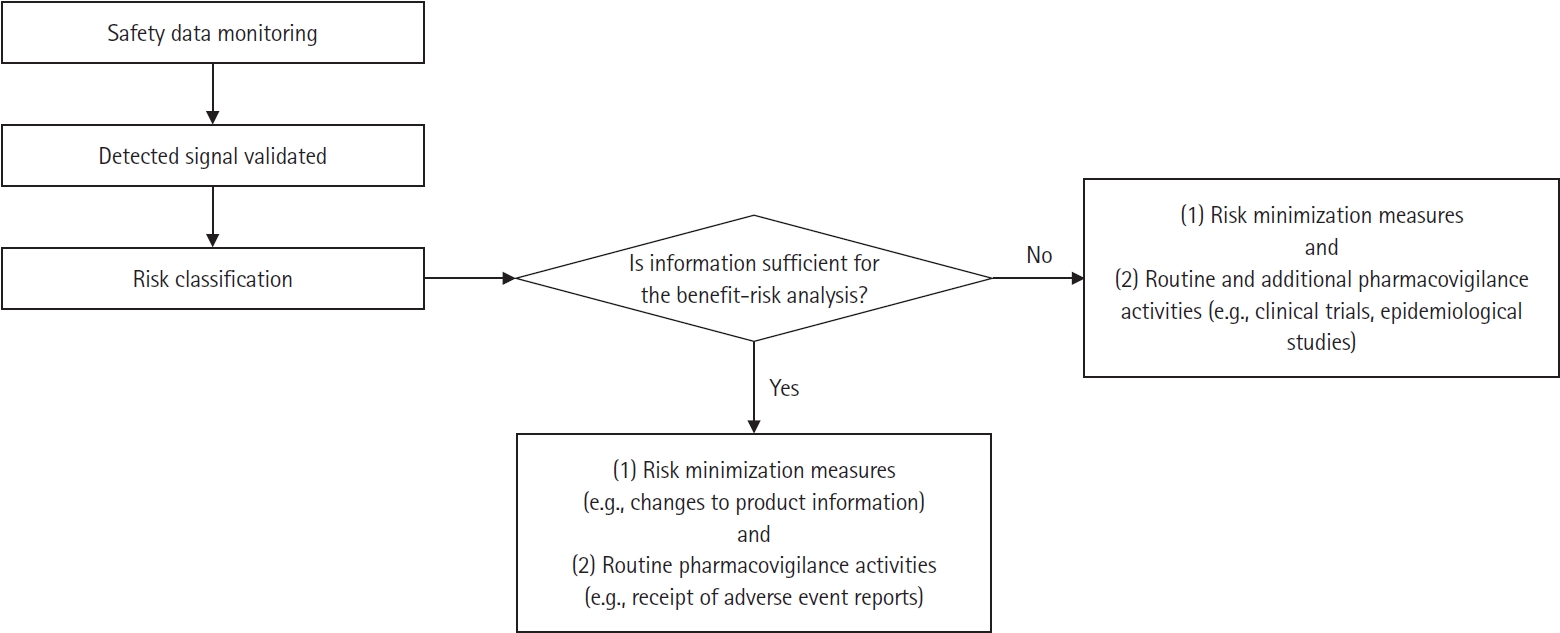
Risk management for medicinal products focuses on safety concerns, which are the primary drivers of a product’s risk-benefit balance. When available information sufficiently characterizes a safety concern, routine (e.g., changes to product information) RMMs alone or a combination of routine and additional (e.g., dear healthcare professional letter) RMMs are implemented. When available information is insufficient to characterize a safety concern and proper risk management is therefore not feasible, additional pharmacovigilance activities (e.g., clinical trials, epidemiological studies) are required to collect further data alongside the implementation of RMMs (
Fig. 1) [
10].
The risk management approach for SKYVaricella is inconsistent. Regulators and the manufacturer acknowledged an increased HZ risk but denied that it constitutes a new safety concern [
3,
7]. The manufacturer introduced educational materials as additional RMMs but omitted essential information (i.e., information recommended by good pharmacovigilance guidelines) about HZ risk [
6,
12], and it did not update the product information [
13], which is a routine RMM. At the same time, the regulatory authorities and manufacturer initiated 3 studies that probably function as additional pharmacovigilance activities, despite their official position that HZ is not a safety concern.
In November 2024, the KDCA issued a call for proposals for an outsourced research project titled “Investigation of the characteristics of children with herpes zoster in Korea for vaccine safety analysis.” Korea University was selected to conduct the study, which was scheduled for completion in December 2025, but no results have been released [
14]. In January 2026, researchers published the cohort profile of the Korean Varicella Immunization Monitoring Scheme. The paper described a national cohort designed to monitor the long-term effectiveness of varicella vaccines in the NIP and noted that long-term effects on HZ incidence would be evaluated in the future. The KDCA provided raw data and research funding for this publication. The study used varicella vaccination record data from the National Immunization Registry (NIR) maintained by the KDCA and varicella infection event data from the Health Insurance Review and Assessment Service (HIRA). Varicella infection events were retrieved using the International Classification of Diseases, 10th Revision (ICD-10) code B01.x. All datasets were linked at the individual level [
15]. The manufacturer also launched a company-sponsored phase 3 clinical trial (ClinicalTrials.gov registration number NCT07415252) to compare the immunogenicity of the lower-potency versions of SKYVaricella with that of Varivax. In the trial, the 2 investigational products are defined as mid- and low-potency versions of SKYVaricella [
16]. Although SK Bioscience stated that the trial aims to support a 2-dose regimen of SKYVaricella for global market expansion [
17], the current dose of SKYVaricella is not being studied for its immunogenicity as a 2-dose regimen in the trial (
Table 1).
These 3 studies reveal several aspects of the Korean authorities’ and manufacturer’s risk management approach: First, implicit acknowledgement of the risk. Despite official denials, commissioning multiple safety studies for a domestically developed product seems unprecedented in Korean regulatory history and suggests recognition of the issue’s significance. Second, a delayed assessment. The cohort study will evaluate HZ risk in the future [
15], even though 7 years of follow-up data for SKYVaricella-vaccinated children already exist. Similar to the cohort study using varicella infection event data, HZ risk can be evaluated using data from the NIR and the 7-year HZ event data from the HIRA, which can be retrieved using the ICD-10 code B02.x. In addition, the phase 3 trial will collect HZ data for 15 months after vaccination, but given the expected incidence rate (i.e., 14 cases per 100,000 person-years for Varivax), HZ onset time after vaccination (i.e., the median onset after vaccination was 605 days for disseminated skin HZ and 260 days for localized HZ), and sample size (i.e., 780 subjects), the total number of HZ cases will be too small to support meaningful comparisons (all SKYVaricella groups would be 2 or fewer, and the Varivax group would be less than 1) [
8,
16,
18]. Third, a potential dose modification. The manufacturer appears to be pursuing a lower-potency formulation, similar to the Suduvax and Barycela sequence, in which a higher-titer version of Suduvax was developed after concerns about its low effectiveness [
9,
19,
20]. SKYVaricella’s current dose demonstrated adequate immunogenicity and acceptable safety in its pivotal trial, making a dose-modification trial without a formal regulatory reassessment unusual.
In summary, the regulatory authorities and manufacturer appear to be delaying a clear evaluation of HZ risk while simultaneously developing a lower-titer version of SKYVaricella.
Conclusion
The new studies initiated by Korean regulatory authorities and the manufacturer following the emergence of safety concerns about SKYVaricella reflect an effort to collect additional data on HZ in the SKYVaricella-vaccinated population. These studies could represent a positive step toward addressing the newly identified risk. However, because the stakeholders have not implemented appropriate RMMs for several years—and because the ongoing studies will not yield meaningful data in the near term—significant concerns remain. The new phase 3 clinical trial, in particular, requires scrutiny, as pursuing a 2-dose regimen is difficult to justify for a vaccine lacking evidence of protective efficacy and of durable immunogenicity.
Effective management of the emerging HZ risk associated with SKYVaricella should include the following actions: (1) Base continued inclusion in the NIP on a valid, updated risk-benefit analysis. (2) Disclose detailed information about the HZ risk transparently and promptly. (3) Ensure consistency across routine RMMs, additional RMMs, and additional pharmacovigilance activities. (4) Implement corrective and preventive actions to reduce similar future cases and minimize public health impact, thereby strengthening Korea’s vaccine safety management system.
-
Authors’ contribution
Conceptualization: JWL. Methodology/formal analysis/validation: JWL. Project administration: JWL. Writing–original draft: JWL. Writing–review & editing: JWL.
-
Conflict of interest
No potential conflict of interest relevant to this article was reported.
-
Funding
None.
-
Data availability
Not applicable.
-
Acknowledgments
None.
-
Supplementary materials
None.
Fig. 1.Risk management flow per the International Council for Harmonisation of Technical Requirements for Pharmaceuticals for Human Use and Good Pharmacovigilance Practices guidelines. This figure summarizes the overall risk management process from safety data monitoring to risk minimization activities and pharmacovigilance activities. Once a detected signal is assessed as valid, it qualifies as either an identified or potential risk. For important identified or important potential risks, appropriate risk minimization activities are implemented to maintain a favorable risk-benefit balance of a medicinal product. When available information is insufficient to characterize these risks, additional pharmacovigilance activities such as clinical trials or epidemiological studies are required to collect more safety information.

Table 1.Studies launched or planned after the emergence of SKYVaricella safety issues
|
No. |
Study title |
Primary study objective |
HZ-related objective |
Study funder |
Study period |
|
1 |
Investigation of the characteristics of children with HZ in Korea for vaccine safety analysis |
Analysis of the origins of varicella-zoster virus in children with HZ, comparison of clinical characteristics by origin, collection of clinical specimens of HZ and genomic analysis |
Primary objectives are HZ-related. |
The KDCA is a funder and Korea University has conducted the study. |
The study period was supposed to be from December 18, 2024 to December 17, 2025. Study results have not been published yet. |
|
2 |
Cohort profile: Korean Varicella Immunization Monitoring (K-VIM) Scheme: a national cohort of children born 2011–2022 |
To assess the long-term effectiveness of the current varicella vaccines in the NIP and to evaluate the real-world impact of 1-dose versus 2-dose vaccination schedules |
To evaluate potential long-term effects on HZ incidence in the vaccinated cohort. |
The KDCA provided the raw data and research funding. Authors were researchers in Korea University. |
The cohort profile introduction was published on January 22, 2026. A future study plan has not been disclosed. |
|
3 |
A phase III, randomized, double-blinded, active-controlled, multinational, multicenter study to assess the safety and immunogenicity of a 2-dose regimen of SKYVaricella (NBP608) in children aged 12 months to 12 years |
Immunogenicity comparisons between mid and low-potency versions of SKYVaricella and Varivax |
HZ is designated as an adverse event of special interest and will be monitored for 15 months after the first vaccination. |
SK Bioscience is a study funder and sponsor. |
The study is planned from June 5, 2026 to January 2, 2028. |
References
- 1. Ministry of Food and Drug Safety. Approval report for a biological medicinal product (SKYVaricella) [Internet]. SK Bioscience; 2018 [cited 2026 Mar 21]. Available from: https://nedrug.mfds.go.kr/pbp/CCBBB01/getItemDetailCache?cacheSeq=201802323aupdateTs2024-05-17%2009:20:08.0b
- 2. Kang HM, Kang KR, Kim YJ, Kang JH, Lee SY. A booster administration of the OKA/SK strain causes fatal disseminated varicella in an immunocompetent child. J Med Virol 2023;95:e29108. https://doi.org/10.1002/jmv.29108
- 3. Korea Disease Control and Prevention Agency (KDCA); Ministry of Food and Drug Safety. Announcement of joint public-private investigation results on the safety of varicella vaccine [Internet]. KDCA; 2024 [cited 2026 Mar 21]. Available from: https://www.kdca.go.kr/kdca/2848/subview.do?enc=Zm5jdDF8QEB8JTJGYmJzJTJGa2RjYSUyRjQyJTJGMjE0OTAyJTJGYXJ0Y2xWaWV3LmRvJTNGcGFzc3dvcmQlM0QlMjZyZ3NCZ25kZVN0ciUzRCUyNmZpbmRPcG53cmQlM0QlMjZmaW5kV29yZCUzRCVFQiVBRiVCQyVFQSVCNCU4MCUyNnJnc0VuZGRlU3RyJTNEJTI2ZmluZFR5cGUlM0RzaiUyNmZpbmRDbFNlcSUzRCUyNnBhZ2UlM0QxJTI2
- 4. SK Bioscience. The summary of the risk management plan [Internet]. SK Bioscience; 2024 [cited 2026 Mar 21]. Available from: https://nedrug.mfds.go.kr/pbp/CCBBB01/getRmpInfo?itemSeq=201802323
- 5. Lee J. Varicella vaccine safety: absence of evidence is not evidence of absence. J Korean Med Sci 2024;39:e245. https://doi.org/10.3346/jkms.2024.39.e245
- 6. SK Bioscience. Guidance for healthcare professionals [Internet]. SK Bioscience; 2024 [cited 2026 Apr 12]. Available from: https://nedrug.mfds.go.kr/pbp/CCBBB01/getRmpDownload?itemSeq=201802323&submitListKind=K
- 7. Kang SG, Kim HY. The importance of accurate communication for public health benefits and commitment to safety monitoring. J Med Virol 2025;97:e70297. https://doi.org/10.1002/jmv.70297
- 8. Kim YJ, Oh D, Kim J, Son J, Moon JY, Kim YK, Ahn B, Kang KR, Park D, Kang HM. Heightened incidence of adverse events associated with a live attenuated varicella vaccine strain that lacks critical genetic polymorphisms in open reading frame 62. Clin Microbiol Infect 2024;30:1466-1473. https://doi.org/10.1016/j.cmi.2024.08.018
- 9. Lee J. The impact of a varicella vaccine introduction on the incidence of herpes zoster in Korean children, an ecological study. Infect Dis (Lond) 2026;58:126-133. https://doi.org/10.1080/23744235.2025.2555896
- 10. European Medicines Agency (EMA). Guideline on good pharmacovigilance practices (GVP): Module V–risk management systems (Rev. 2) [Internet]. EMA; 2024 [cited 2026 Mar 21]. Available from: https://www.ema.europa.eu/en/documents/scientific-guideline/guideline-good-pharmacovigilance-practices-module-v-risk-management-systems-rev-2_en.pdf
- 11. Council for International Organizations of Medical Sciences (CIOMS). Practical aspects of signal detection in pharmacovigilance: report of CIOMS Working Group VIII. CIOMS; 2010.
- 12. European Medicines Agency (EMA). Guideline on good pharmacovigilance practices: Module XV–safety communication (Rev. 1) [Internet]. EMA; 2017 [cited 2026 Apr 12]. Available from: https://www.ema.europa.eu/en/documents/scientific-guideline/guideline-good-pharmacovigilance-practices-module-xv-safety-communication-rev-1_en.pdf
- 13. SK Bioscience. Product information, SKYVaricella [Internet]. SK Bioscience; 2024 [cited 2026 Apr 12]. Available from: https://nedrug.mfds.go.kr/pbp/CCBBB01/getItemDetailCache?cacheSeq=201802323aupdateTs2026-03-25%2019:36:59.32028b
- 14. Korea Disease Control and Prevention Agency (KDCA). [Outsourced project] Call for proposals: “Investigation of the characteristics of children with herpes zoster in Korea for vaccine safety analysis” [Internet]. KDCA; 2024 [cited 2026 Mar 21]. Available from: https://www.kdca.go.kr/kdca/2858/subview.do?enc=Zm5jdDF8QEB8JTJGYmJzJTJGa2RjYSUyRjUxJTJGMjI0NTIxJTJGYXJ0Y2xWaWV3LmRvJTNGcGFzc3dvcmQlM0QlMjZyZ3NCZ25kZVN0ciUzRCUyNmZpbmRPcG53cmQlM0QlMjZmaW5kV29yZCUzRCVFQiU4QyU4MCVFQyU4MyU4MSVFRCU4RiVBQyVFQyVBNyU4NCUyNnJnc0VuZGRlU3RyJTNEJTI2ZmluZFR5cGUlM0RzaiUyNmZpbmRDbFNlcSUzRCUyNnBhZ2UlM0QxJTI2
- 15. Shim YK, Lee YH, Choe YJ, Yoon Y, Kim YK. Cohort profile: Korean Varicella Immunization Monitoring (K-VIM) Scheme: a national cohort of children born 2011-2022. Epidemiol Health 2026;48:e2026005. https://doi.org/10.4178/epih.e2026005
- 16. SK Bioscience. SkyVaricella (NBP608) vaccine with lower potencies in healthy children aged 12 months to 12 years [Internet]. SK Bioscience; 2026 [cited 2026 Mar 21]. Available from: https://clinicaltrials.gov/study/NCT07415252?intr=nbp608&rank=1
- 17. SK Bioscience. SK Bioscience submits IND for phase 3 clinical trial of 2-dose varicella vaccine [Internet]. SK Bioscience; 2025 [cited 2026 Apr 12]. Available from: https://www.skbioscience.com/en/news/news_01_01?mode=2&id=319&page=2
- 18. Merck Sharp & Dohme (UK) Limited. Summary of product characteristics: Varivax [Internet]. Merck; 2026 [cited 2026 Apr 12]. Available from: https://www.medicines.org.uk/emc/product/5582/smpc
- 19. Lee YH, Choe YJ, Cho SI, Kang CR, Bang JH, Oh MD, Lee JK. Effectiveness of varicella vaccination program in preventing laboratory-confirmed cases in children in Seoul, Korea. J Korean Med Sci 2016;31:1897-1901. https://doi.org/10.3346/jkms.2016.31.12.1897
- 20. Umit Z, Sahbudak Bal Z, Zeytinoglu A, Gulbahar Aydogan T, Bag O, Guner Ozenen G, Ozkinay F, Kurugol Z. The comparison of seroconversion rates among different varicella vaccines administered Turkish children; MAV/06 and vOka. Hum Vaccin Immunother 2021;17:4190-4193. https://doi.org/10.1080/21645515.2021.1967037
Citations
Citations to this article as recorded by

- Letter regarding a herpes zoster outbreak in Korean children: insights from an additional 14 months of data
Joowon Lee
Infectious Diseases.2026; 58(7): 738. CrossRef