

| Eunbi Cho | 3 Articles |
|
[English]
Purpose
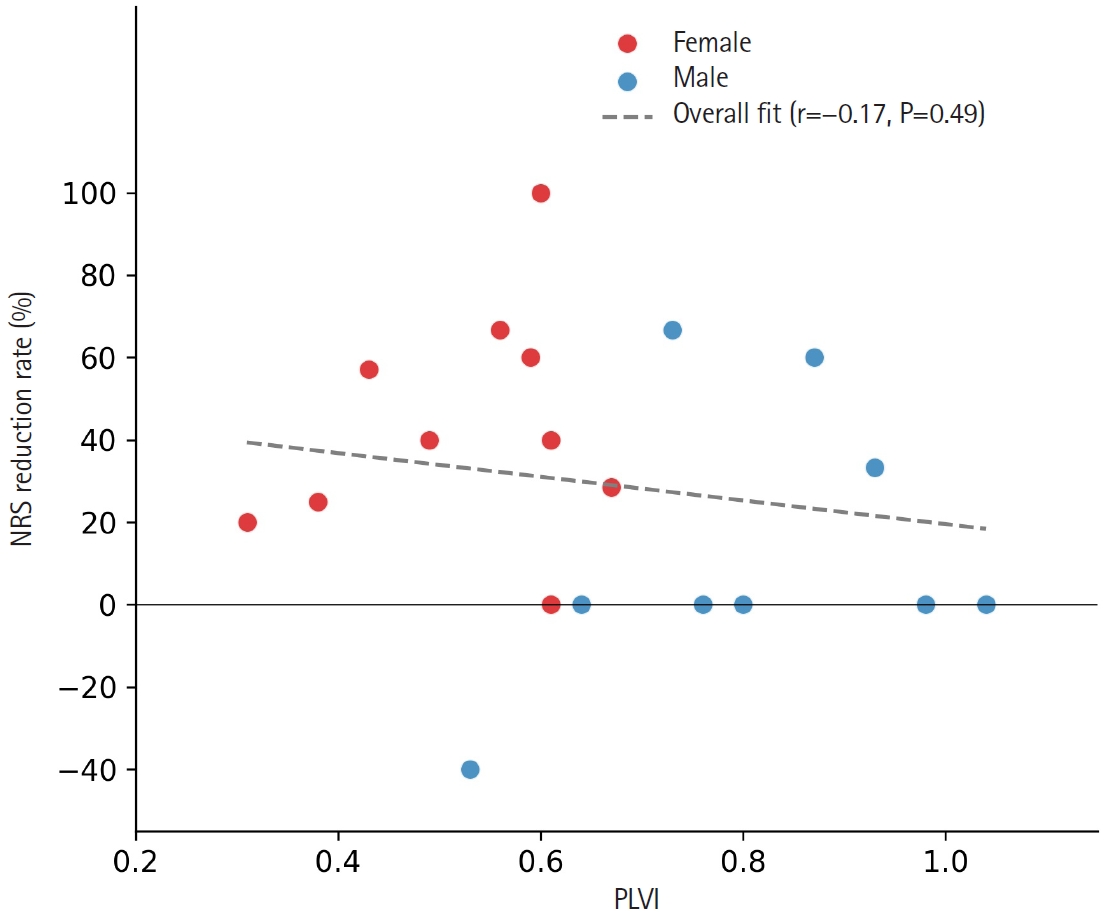
The psoas–lumbar vertebral index (PLVI), a marker of central sarcopenia measured using computed tomography (CT) or magnetic resonance imaging (MRI), has been linked to the development of postherpetic neuralgia (PHN). Whether PLVI predicts short-term pain relief after pulsed radiofrequency (pRF) treatment of the dorsal root ganglion (DRG) in established PHN remains unknown. This pilot study examined the association between PLVI and the reduction in numeric rating scale (NRS) pain scores 1 month after pRF. Methods Patients with PHN who underwent DRG pRF and had CT or MRI scans available for PLVI measurement were retrospectively reviewed. Correlations of the NRS reduction rate with PLVI and other variables were assessed, with 95% confidence intervals (CIs). Patients were divided into low- and high-PLVI groups using sex-specific medians and compared; multivariable regression was adjusted for sex. A supplementary responder analysis used thresholds of ≥30% and ≥50% reduction. Results In 19 patients, NRS scores decreased from 4.8±1.7 to 3.2±1.7, with a reduction rate of 29.3%±34.0%. PLVI was not significantly correlated with the reduction rate (r=−0.17; 95% CI, −0.58 to 0.31; P=0.49); neither the reduction rate (P=0.71) nor responder rates differed between the low- and high-PLVI groups. Male sex was associated with a smaller reduction (adjusted B=−47.2 percentage points; 95% CI, −90.9 to −3.5; P=0.036), although the unadjusted group comparison was not significant (Welch P=0.051) and 15 variables were tested without correction for multiple comparisons. Conclusion This pilot cohort showed no detectable association between PLVI and short-term pain relief after pRF; its small size precludes establishing the absence of an association. The exploratory sex difference warrants investigation in larger prospective studies with comprehensive sarcopenia assessment.
[English]
Purpose
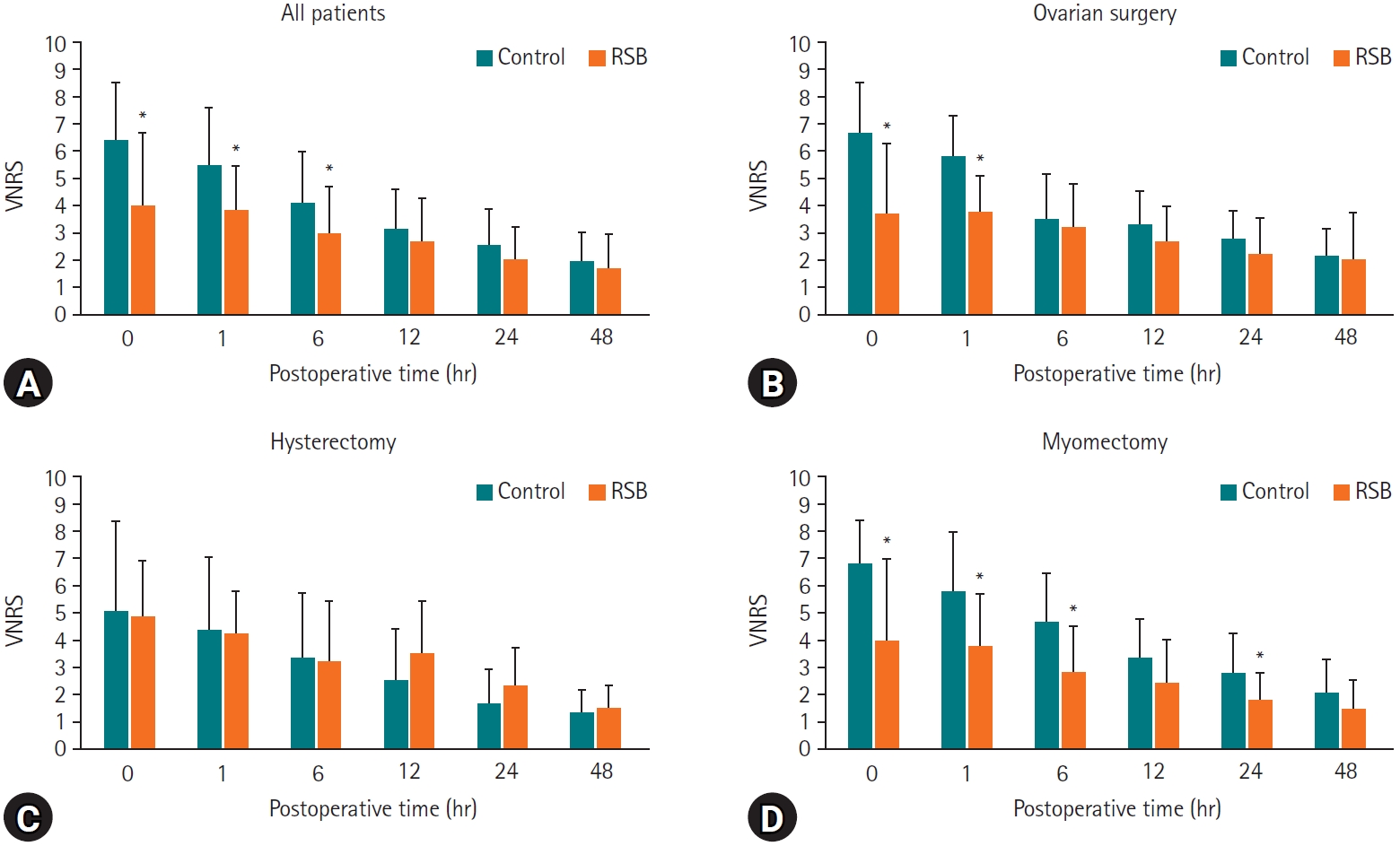
Rectus sheath block (RSB) is a simple abdominal wall block that can be readily applied. This study evaluated the postoperative analgesic efficacy of ultrasound-guided bilateral RSB in robotic single-site gynecologic surgery. Methods Sixty patients were randomly assigned to the RSB group (n=30) or the control group (n=30). After induction of general anesthesia, patients in the RSB group received ultrasound-guided bilateral RSB with 30 mL of 0.25% ropivacaine. Pain intensity was assessed using a verbal numerical rating scale (VNRS) at 0, 1, 6, 12, 24, and 48 hours postoperatively. Intravenous patient-controlled analgesia was provided to all patients, and fentanyl was administered as rescue analgesia on request. Results VNRS scores at 0, 1, and 6 hours were significantly lower in the RSB group than in the control group (all P<0.05). Rescue fentanyl use in the post-anesthesia care unit was also significantly lower in the RSB group than in the control group (19.8±21.0 μg vs. 46.3±27.6 μg, P<0.001). Subgroup analysis showed that RSB was associated with lower VNRS scores in patients undergoing ovarian surgery or myomectomy, whereas no significant difference was observed in patients undergoing hysterectomy. Conclusion Ultrasound-guided bilateral RSB reduced early postoperative pain and rescue analgesic requirements after robotic single-site gynecologic surgery.
[English]
Purpose
Lipid emulsion is the only specific antidote for local anesthetic systemic toxicity, but no dose-finding study has been conducted. We compared 3 published regimens and alternative schedules that deliver the same dose in different ways using a human model of intravenous bupivacaine overdose. Methods A 14-compartment human bupivacaine model was independently reimplemented without fitted parameters, replacing first-order lipid elimination with a saturable term. Toxicity was modeled as 112.5 mg administered intravenously over 3 minutes. Benefit was defined as the predicted maximum decrease in myocardial bupivacaine within 30 minutes, and harm as the predicted relative lipid load, indexed by peak plasma triglyceride concentration. Neither measure is a validated surrogate. Results The 3 guidelines specify the same doses but different bolus durations: 1 minute versus 2–3 minutes. At a matched dose of 12 mL/kg, myocardial bupivacaine decreased by 30.5% with the 1-minute bolus and 24.9% with the 2.5-minute bolus, with the same lipid load. The completed American Society of Regional Anesthesia and Pain Medicine regimen (7.64 mL/kg) achieved a 24.6% decrease versus 24.9% with 12 mL/kg; thus, complete regimens differ in schedule as well as dose. Repeating the 1-minute bolus twice, for a total of 4.5 mL/kg, achieved a 31.9% decrease with 62% less emulsion. Start time had the greatest effect: the best regimen achieved a 41.8% decrease when started at the end of the injection, but only 9.6% when started at 10 minutes. Conclusion In this bupivacaine model, bolus duration distinguished the regimens more than dose did, and delay had a greater effect than either, eliminating most of the benefit without changing the lipid load. Treatment should begin at the first signs of toxicity, and 20% lipid emulsion should be immediately available wherever local anesthetics are used.
|
|
 , Eunbi Cho